The new edition of ISO 9001, the international reference standard for Quality Management Systems, has been published. ISO 9001:2026 replaces ISO 9001:2015, including Amendment Amd1:2024, introducing an evolutionary update to the requirements along with several important clarifications.
For organizations that are already certified, transitioning to the new edition does not require a complete overhaul of their Management System. The changes are in fact limited in scope and mainly concern certain requirements, definitions and interpretative aspects that will need to be incorporated and integrated into the existing system.
What changes with ISO 9001:2026?
The areas most significantly affected by the new edition of the standard include:
Quality culture and ethical behavior
The new standard places greater emphasis on the role of leadership in promoting and consolidating a quality-oriented culture and the adoption of ethical behavior within the organization. This topic is also linked to the awareness of people working within the organization.
Risks and opportunities
The management of risks and opportunities is clarified through a more clearly defined distinction between their identification and determination and the subsequent actions required to address them.
Change management
ISO 9001:2026 places greater emphasis on the management of changes. Monitoring and evaluating the effectiveness of changes, communicating them, and reviewing the results achieved become particularly relevant.
Management review
The management review explicitly highlights the need to consider the evolving needs and expectations of relevant interested parties for the Quality Management System.
Documented information and terminology
The new edition updates certain definitions and introduces clarifications regarding the availability of documented information, helping to make the application of the requirements clearer.
Annexes to the standard
The structure of the annexes has also been updated. Annex A, which is informative in nature, has been revised to provide further clarification on the application of the requirements, while Annex B has been removed.
What does the transition mean for certified organizations?
For companies already certified to ISO 9001:2015, the process should begin with a gap analysis between the existing Management System and the requirements of ISO 9001:2026.
The aim is to identify any necessary adjustments at an early stage, paying particular attention to:
- how a quality culture is promoted within the organization;
- the identification and management of risks and opportunities;
- the planning, communication, monitoring and evaluation of changes;
- consideration of the needs and expectations of interested parties;
- procedures, documented information and competencies that may require updating.
The extent of the changes required may vary depending on the structure, processes and level of maturity of each organization’s Management System.
Transitioning to ISO 9001:2026: key deadlines
The transition to the new edition of the standard will take place over the specified transition period.
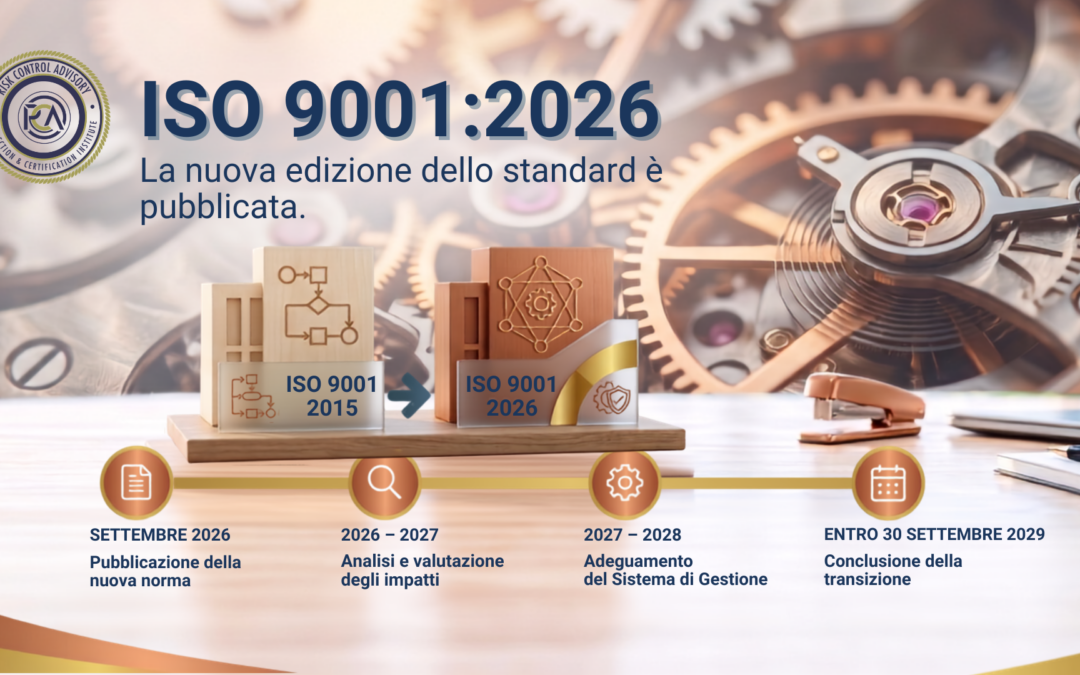
September 2026 – Publication of ISO 9001:2026
The new edition of the standard is officially available, and organizations can begin their analysis and planning activities.
2026–2027 – Impact analysis
This is the ideal time to compare the current Management System with the new requirements and identify the areas that may require adjustments.
2027–2028 – Adjustment of the Management System
Organizations can proceed with implementing the identified changes, making adjustments, where necessary, to processes, documentation, competencies and operating methods.
From 2028 – Audits according to the new edition
New certification activities will be conducted in accordance with the requirements of ISO 9001:2026, within the framework of the arrangements established for the transition.
By 30 September 2029 – Completion of the transition
The transition to the new edition must be completed by this date. At the end of the transition period, certifications based on the previous ISO 9001:2015 edition will no longer be valid.
Why start preparing now?
The transition can be managed gradually by integrating the necessary adjustment activities into the normal management cycle of the Quality Management System.
A preliminary analysis makes it possible to understand in advance which areas require action, plan the necessary activities and complete the transition without having to concentrate all the adjustments during the final stages of the transition period.
RCA supporting organizations through the transition
RCA supports organizations on their journey towards the new ISO 9001:2026, providing expertise and tools to help them manage the transition process with awareness and confidence.
Would you like to know how to prepare your organization for ISO 9001:2026?
Contact RCA to learn more about the transition process and timelines and to identify the approach best suited to your company’s needs.